The Concept of Three-Dimensionality: Why the Sea Changes the Way We Move
|| ScubaLiveTV || Insights || Actuality || Interviews || TV Web || History || Scuba Diving || Freediving || Video collection || Nature and Environment || Collaborate with us ||
Stay up to date on our activities Subscribe to our Newsletter
The Concept of Three-Dimensionality: Why the Sea Changes the Way We Move Underwater, the body stops moving on a plane and learns to exist in space. This is where a new awareness of movement begins.
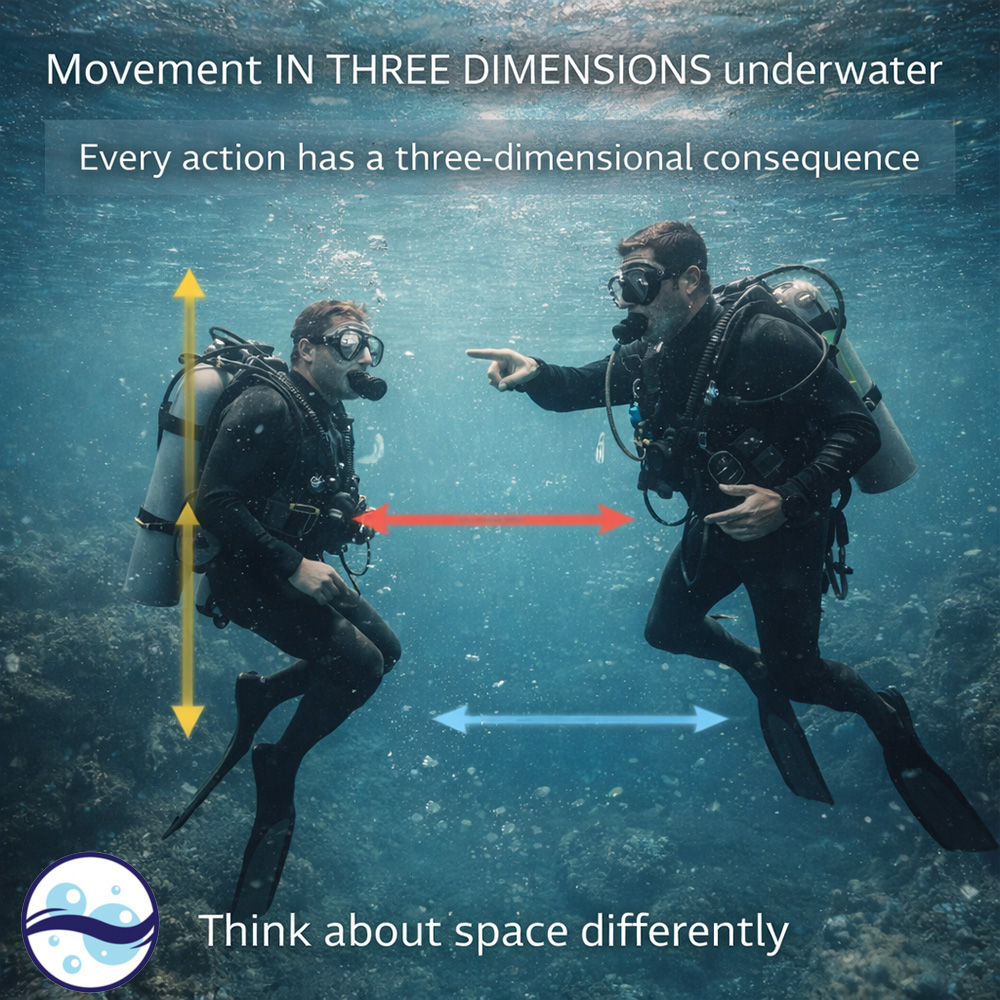
When I teach a student how to move underwater, the first thing I aim to convey is not a finning technique or hand position. It is something much deeper: underwater, movement is no longer two-dimensional, but fully three-dimensional.
On land, we live in a predominantly two-dimensional world. We move forwards, backwards, and sideways. Even when climbing stairs or descending slopes, movement remains constrained by gravity and constant contact with the ground. The body is always oriented downward, supported by a stable and reassuring reference.
The sea removes that reference.
Underwater, the body enters a truly three-dimensional environment, where forward, backward, up, and down carry equal importance. There is no absolute “up” and no mandatory “down”. Orientation becomes relative, shaped by buoyancy, breathing, and perception.
From a physical standpoint, buoyancy counteracts much of the body’s weight. This fundamentally alters how muscles function. Instead of supporting the body against gravity, they work to stabilise it within space. Deep postural muscles—often underused on land—become continuously active to maintain balance and control.
Neurologically, the brain must reorganise spatial references. Vision, balance, and proprioception no longer receive signals consistent with terrestrial experience. This is why many divers initially feel disoriented: they are not making mistakes—they are learning a new movement language.
A practical example makes this clear.
I often ask students to stop in neutral buoyancy mid-water, without moving their fins. On land, standing still is easy: you simply do nothing. Underwater, it is not. A slightly deeper breath or a small hand movement causes the body to drift upward, downward, or forward. In that moment, the body understands that every action has a three-dimensional consequence.
This is where true control begins.
An experienced diver does not simply swim—they occupy space. Movement is intentional. Breathing is used to ascend and descend, buoyancy to glide forward effortlessly, posture to reduce drag. This applies to scuba diving, but becomes even more evident in freediving, where every movement has a direct energetic cost.
Understanding three-dimensionality also enhances safety. A diver who perceives space accurately can maintain distances, avoid contact with the seabed, and move near walls or wrecks without losing control. They read their body in space and make clearer, more informed decisions.
At Underwater Academy, this concept is introduced from the very first dives—not as abstract theory, but as lived experience. Whether through scuba diving, freediving, or mermaid courses, learning to move in three dimensions is a fundamental step toward truly becoming part of the marine environment.
The sea does not only teach us how to breathe or swim.
It teaches us to think about movement differently.
And from this understanding comes a more aware, more elegant, and safer way of diving.
Discover Underwater Academy’s scuba diving, freediving, and mermaid courses and learn to move underwater with control, balance, and awareness.
- PADI Project AWARE Specialist – Protect aquatic environments

- PADI EFR CARE FOR CHILDREN

- PADI Discover Scuba Diver


| YouTube | facebook | instagram | WhatsApp or telegram group |