Pressure and Depth: How the Human Body Reacts During a Dive
|| ScubaLiveTV || Insights || Actuality || Interviews || TV Web || History || Scuba Diving || Freediving || Video collection || Nature and Environment || Collaborate with us ||
Stay up to date on our activities Subscribe to our Newsletter
Pressure and Depth: How the Human Body Reacts During a Dive
The physics of diving is not just about numbers and laws: it is a continuous dialogue between the human body and an environment that reshapes every internal balance.
Every dive begins with a simple action: descending. Yet behind this seemingly natural movement, a profound transformation takes place. The human body, designed to live in air, gradually enters an environment where pressure becomes the dominant force—silent, constant, and unavoidable. Understanding how the body responds to this change is essential for diving with greater safety, clarity, and respect for personal limits.
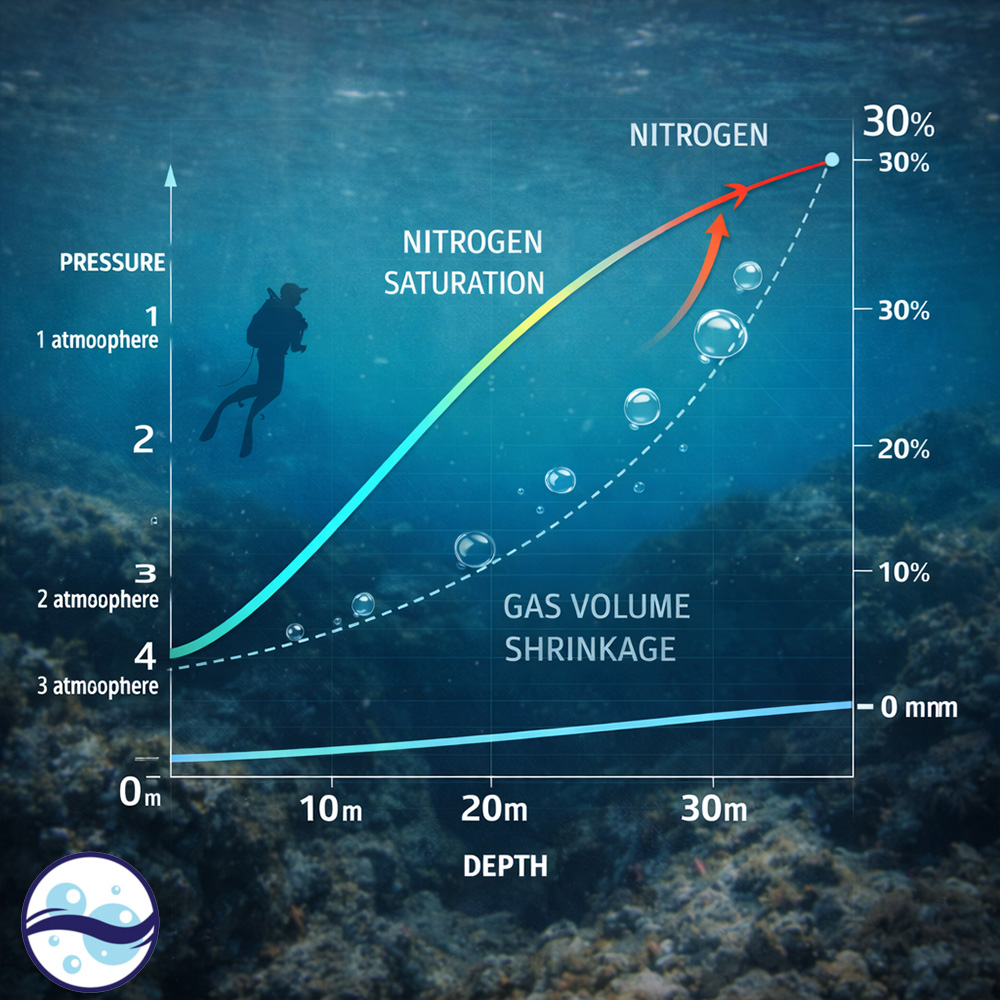
Pressure increases rapidly underwater. Every ten metres of depth add one atmosphere compared to the surface. This increase is not felt as an external push, but rather through the body’s internal responses as it tries to restore balance in an environment that constantly challenges it.
The first reactions occur in the air-filled spaces of the body. As a diver descends, air compresses and the body signals this immediately. A growing sense of tension, discomfort, or even sharp pain is not an obstacle but a clear message. The body is asking for time and attention. Equalisation, therefore, is not a purely technical action, but an act of awareness that connects depth, rhythm, and listening.
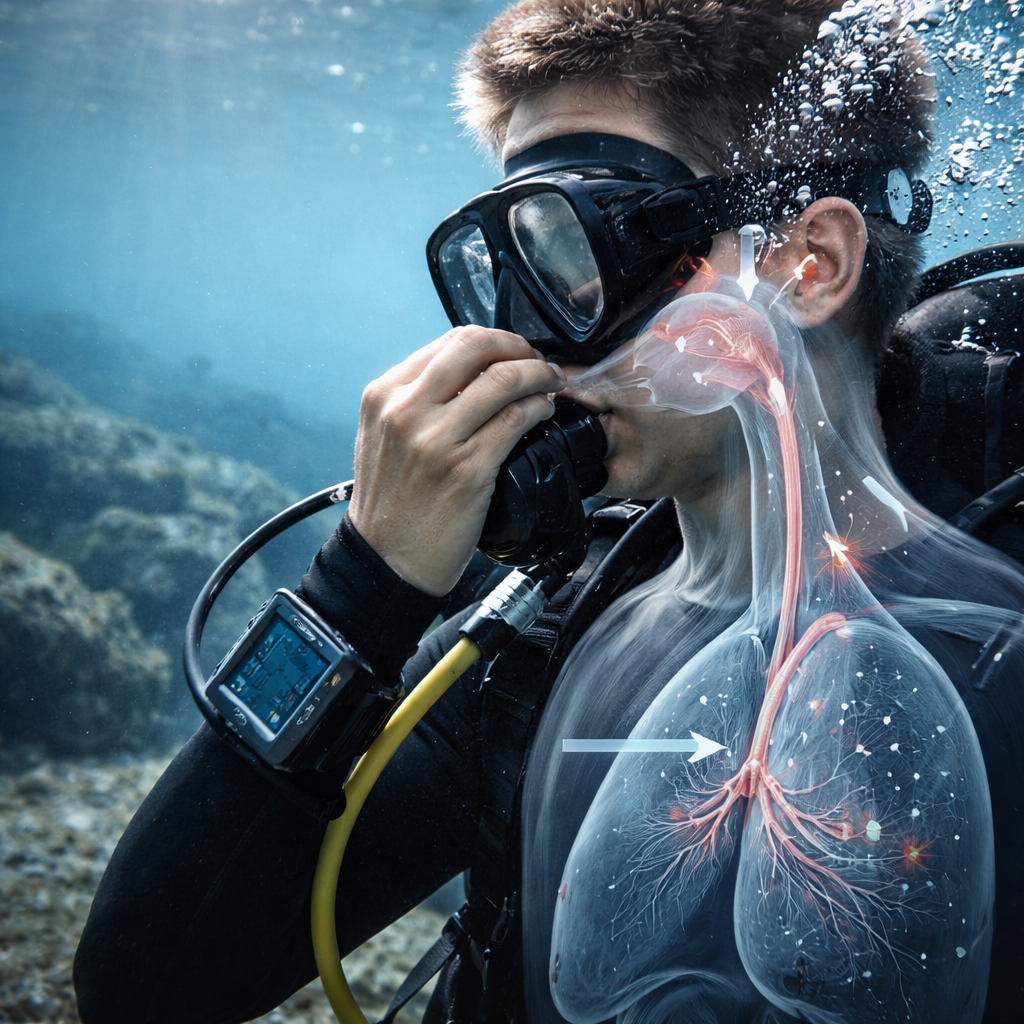
Breathing also undergoes a significant transformation. In scuba diving, the regulator delivers air at ambient pressure, allowing the lungs to function without collapsing. This artificial balance is what makes modern diving possible. In freediving, however, the body faces a very different reality. Lung volume progressively decreases, and the organism activates remarkable physiological adaptations. The chest becomes more flexible, blood is drawn towards the lungs to protect them, and relaxation is no longer optional—it becomes essential.
This is where an often-overlooked truth emerges: depth is not achieved through force, but through the ability to release unnecessary tension. In freediving programmes such as those offered by Underwater Academy, this principle is taught as a cornerstone of safety, long before performance.
Another less visible yet crucial aspect concerns the behaviour of gases within the body. As pressure increases, greater amounts of gas dissolve into the tissues. Nitrogen, in particular, can alter perception, slow cognitive processes, and affect decision-making. This change is subtle and not always immediately recognised. For this reason, careful dive planning, respect for limits, and controlled ascents are not mere rules, but essential protective tools.
Time itself feels different underwater. Subjectively, divers may experience a sense of calm and expansion, but physiologically every minute spent at depth carries greater weight. Pressure accelerates certain processes and reduces margins for error. Understanding the relationship between depth and time therefore improves decision-making, reduces risk, and enhances natural control of buoyancy and breathing.
The physics of diving is not an abstract discipline. It is the scientific description of what the body truly experiences with every metre of descent. In the scuba, freediving, and specialty courses offered by Underwater Academy, this knowledge is shared as part of a broader marine culture, not simply as theory.
Because underwater, success does not belong to those who go deeper, but to those who understand what is happening within themselves.
- PADI Professional Freediving Courses

- PADI Freediving Specialty Courses

- PADI Freediving Recreational Courses


- Children’s Program and 1st Level Mermaid Junior Course
- Mermaid Junior 2nd Level Course

- 1st level memaid course for adults

| YouTube | facebook | instagram | WhatsApp or telegram group |