Physics of Diving: Why the Human Body Changes Underwater
|| ScubaLiveTV || Insights || Actuality || Interviews || TV Web || History || Scuba Diving || Freediving || Video collection || Nature and Environment || Collaborate with us ||
Stay up to date on our activities Subscribe to our Newsletter
Physics of Diving: Why the Human Body Changes Underwater
Entering the water and descending below the surface is not a neutral act for the human body. Even at shallow depths, the laws of physics change, and with them the way our body functions, reacts, and adapts. Understanding the physics of diving is not merely theoretical—it is a cornerstone of safety in both scuba diving and freediving.
Pressure: the invisible force
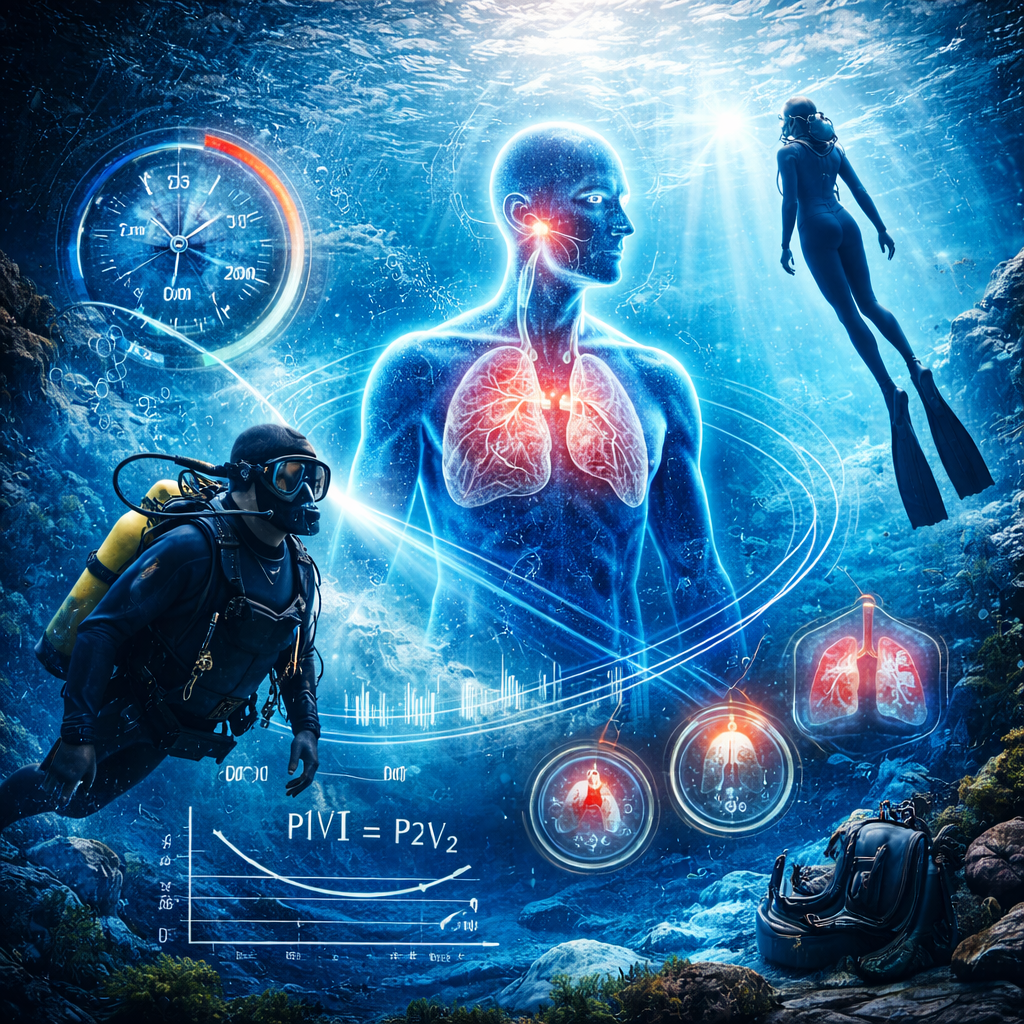
The first major change is pressure. At the surface we live at 1 atmosphere; underwater, pressure increases by one atmosphere every 10 metres. This means the body is progressively “compressed” by the surrounding environment.
The main effects of pressure involve:
- ears and sinuses
- lungs
- mask
- air spaces within the body
This is why equalisation is one of the first skills taught in scuba diving and freediving courses at Underwater Academy: ignoring physics can lead to pain or injury.
Air compresses (and expands)
According to Boyle’s Law, the volume of a gas decreases as pressure increases. Underwater, this translates into a simple but crucial fact: air occupies less space during descent and more space during ascent.
For scuba divers, this affects:
- buoyancy and trim
- air consumption
- ascent control
For freedivers, lung compression becomes one of the main physiological challenges, addressed only through proper technique, gradual progression, and structured training.
The body adapts: the diving reflex
When the face enters the water—especially cold water—the body automatically activates the diving reflex: a set of physiological responses that slow the heart rate, reduce peripheral blood flow, and protect vital organs.
This mechanism is particularly evident in freediving but is also present in scuba diving. It is one of the reasons many divers experience a deep sense of calm underwater.
Buoyancy and trim: the body no longer weighs the same
Underwater, the perceived weight of the body changes dramatically. Archimedes’ principle counteracts gravity and allows the diver to achieve neutral buoyancy, a state in which they neither sink nor float.
Learning to manage buoyancy means:
- moving with less effort
- reducing air consumption
- protecting the seabed and marine life
It is a core skill in recreational scuba courses and advanced specialisations.
Cold, circulation, and energy consumption
Water conducts heat far more efficiently than air. Even in seemingly mild conditions, the body loses heat quickly. This affects:
- blood circulation
- muscle stiffness
- increased energy consumption
This is why proper thermal protection and effort management are integral parts of scuba diving and freediving training.
Understanding physics to dive better
The physics of diving is not an obstacle—it is a guide. Knowing why the body changes underwater allows divers to anticipate reactions, prevent problems, and fully enjoy the experience.
Whether scuba diving, freediving, or mermaid diving, every discipline is based on the same principle: working with the laws of physics, not against them. This is the approach promoted by Underwater Academy through structured training pathways, from first dives to advanced specialisations.


| YouTube | facebook | instagram | WhatsApp or telegram group |