
Marine Safety: The New Regulations Every Diver Must Know
|| ScubaLiveTV || Insights || Actuality || Interviews || TV Web || History || Scuba Diving || Freediving || Video collection || Nature and Environment || Collaborate with us ||
Stay up to date on our activities Subscribe to our Newsletter
Marine Safety: The New Regulations Every Diver Must Know
Between rules, responsibility, and awareness: what is really changing for scuba divers, freedivers, and dive centres.
Marine safety is no longer just a matter of common sense or personal experience. It has become a shared responsibility, increasingly governed by regulations that involve scuba divers, freedivers, dive centres, and marine operators alike. In recent years, the legal framework has evolved to respond to new challenges: higher sea traffic, overlapping activities, and the need to prevent avoidable accidents.
Knowing the rules does not limit freedom underwater—it protects lives.
Why regulations are evolving
The sea is more crowded than ever. Recreational divers, freedivers, boaters, jet skis, and commercial activities now share the same spaces. Many incidents occur not because of extreme conditions, but due to poor communication and lack of regulatory awareness.
New regulations aim to:
- improve visibility of underwater activities
- reduce collision risks
- clarify legal responsibilities
- standardise safety behaviour
Dive signalling: visibility saves lives
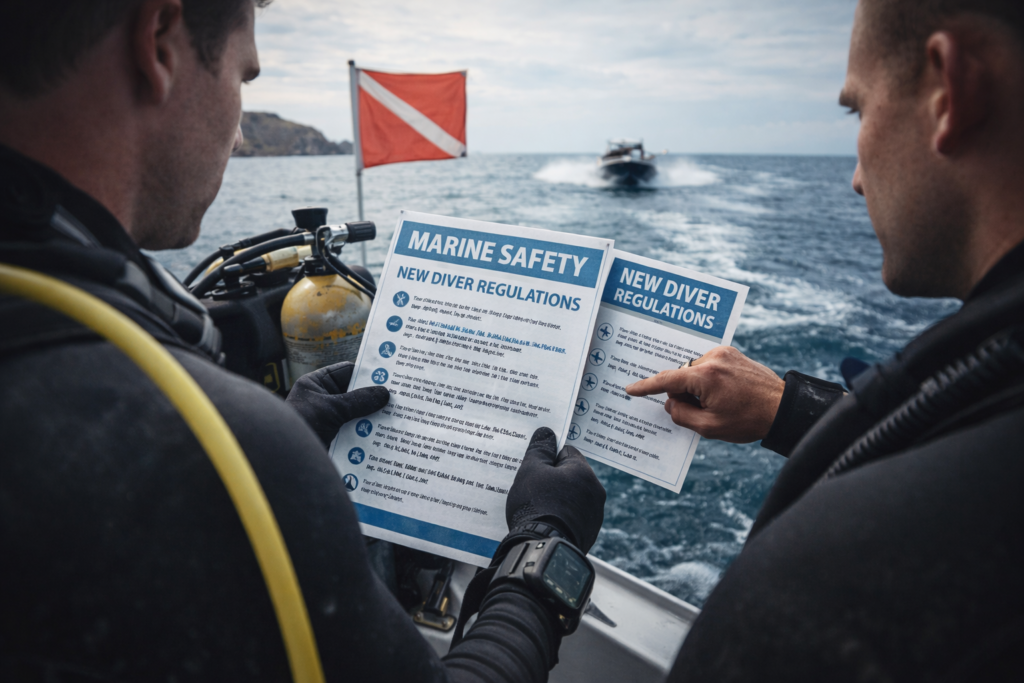
One of the most reinforced aspects concerns the signalling of diving activity. The correct use of the diver-down flag is now central—not only for dive centres, but also for individual scuba divers and freedivers.
Regulations emphasise:
- mandatory, clearly visible signalling
- minimum safety distances for vessels
- correct positioning of surface markers
Ignoring these rules can lead to serious, often underestimated, consequences.
The diver’s personal responsibility
Modern regulations strongly highlight individual responsibility. Certification alone is not enough—every diver is accountable for their operational decisions.
This includes:
- assessing sea and weather conditions
- respecting certification limits
- diving in pairs or organised groups
- using suitable, well-maintained equipment
In Underwater Academy’s scuba and specialty courses, these principles are reinforced continuously: safety is not bureaucracy—it is culture.
Freediving and increased regulatory focus
Freediving is also receiving greater regulatory attention, particularly in busy or protected areas. Authorities emphasise:
- buddy-based practice
- continuous surface signalling
- safe distances from vessels
Within Underwater Academy freediving programmes, safety is taught as an essential part of the experience, not as a limitation to performance.
The role of dive centres
Dive centres are now required to meet higher standards, including:
- documented safety briefings
- environmental condition assessments
- group management based on experience levels
- strict compliance with local and national laws
These regulations protect not only divers, but also operators themselves.
Safety and the marine environment
An often-overlooked aspect is the link between safety and environmental protection. Clear rules help reduce:
- damaging anchoring practices
- invasive behaviour
- unmanaged overcrowding
Marine safety and environmental respect are not separate concepts they are part of the same responsible approach to the sea.
Staying informed is part of the dive
Regulations can vary significantly by country and region. Staying informed before entering the water is now a core responsibility of the modern diver. Underwater Academy promotes a training philosophy where continuous education, awareness, and respect for regulations are integral to every diving experience from first certification to advanced specialisations.



- Become a scuba diver in a weekend in Malta

- PADI Freediver Instructor Crossover – Malta

- Become a PADI Freediver Instructor: Upcoming Course in Malta – October 23, 24, 25 & 26

| YouTube | facebook | instagram | WhatsApp or telegram group |