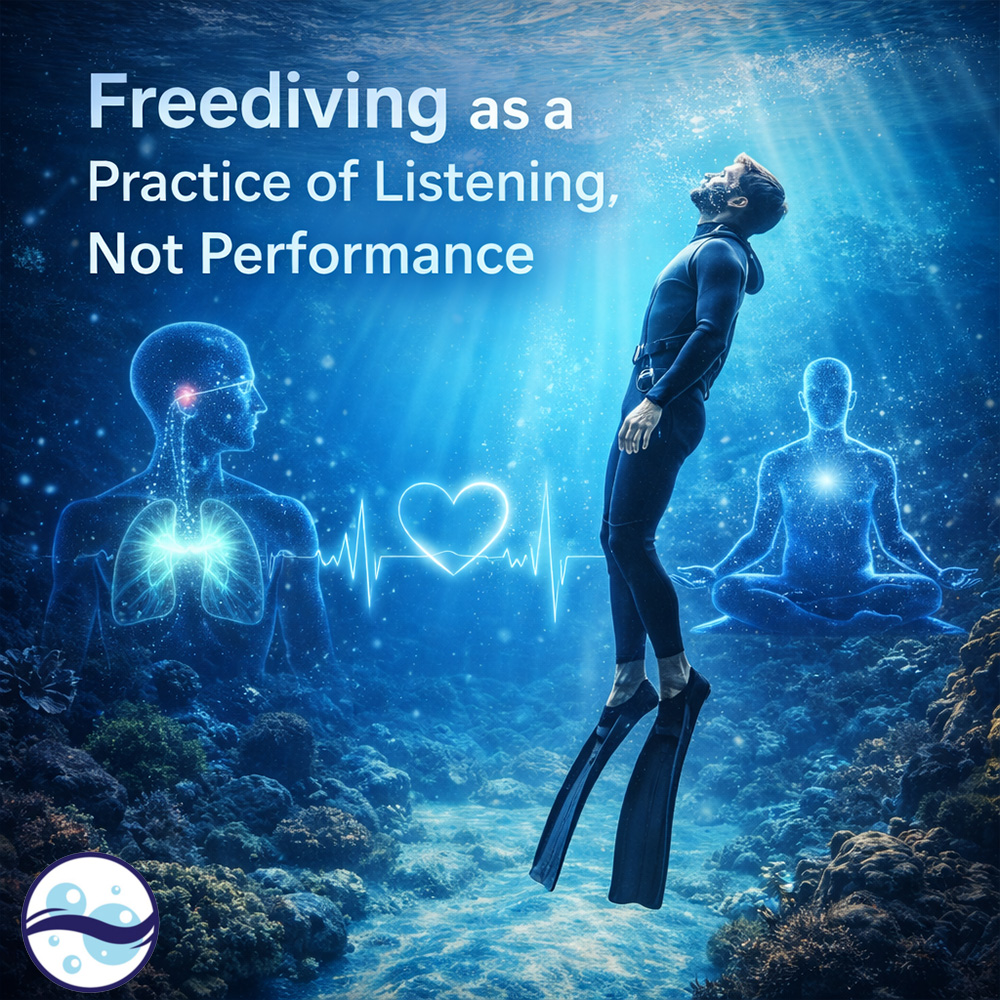
Freediving as a Practice of Listening, Not Performance
|| ScubaLiveTV || Insights || Actuality || Interviews || TV Web || History || Scuba Diving || Freediving || Video collection || Nature and Environment || Collaborate with us ||
Stay up to date on our activities Subscribe to our Newsletter
Freediving as a Practice of Listening, Not Performance
For a long time, freediving has been described almost exclusively through numbers: metres, seconds, records. Greater depths, longer breath-holds. But there is another way to experience freediving—quieter and less visible—one that has nothing to do with competition. It is freediving as a practice of listening, not performance.
An approach that does not ask the body to endure, but to communicate.
Listening before holding the breath
In the modern world, we are used to pushing: doing more, going further, exceeding limits. Freediving, when practised with awareness, does the opposite. It asks us to slow down and to perceive the breath before attempting to control it.
Before every freedive there is a crucial moment: listening to the body. Heart rate, muscle tension, mental state. Ignoring these signals leads to forcing. Acknowledging them means entering the water already in balance.
This is one of the core concepts taught in Underwater Academy’s freediving courses, especially in orientation programmes and beginner levels: it is not about how long you stay underwater, but how you get there.
The body as an ally, not a limit
In a performance-driven mindset, the body is often seen as an obstacle to overcome. In conscious freediving, the body becomes a compass. Sensations—from relaxation to the first contractions—are not enemies, but messages.
Learning to recognise them allows you to:
- improve safety
- reduce stress
- increase comfort underwater
- build a natural and sustainable progression
This applies to static, dynamic, and depth freediving alike.
The mind descends before the body
One of the most fascinating aspects of freediving is its impact on the mind. As breathing slows, thoughts drift further away. Attention moves from the outside to the inside. It is a form of presence rarely experienced in everyday life.
For many practitioners, freediving becomes a genuine practice of awareness, similar to meditation. You do not dive to prove something, but to feel. You do not hold your breath to beat a time, but to enter a state of deep calm.

Listening does not mean improvising. On the contrary, true listening is built on solid training. Understanding physiology, bodily responses, and safety procedures allows divers to distinguish between what is normal and what is a warning signal.
In Underwater Academy’s freediving programmes, listening is always combined with:
- buddy diving
- clear safety protocols
- gradual progression
- absolute respect for personal limits
Because freediving is not solitary introspection, but a relationship: with your buddy, with the environment, and with yourself.
Beyond freediving: a different way of being in the water
This approach also influences other disciplines. Many recreational scuba divers discover, through freediving, a calmer way of moving underwater. The same applies to mermaid diving, where control, listening, and fluidity are as essential as aesthetics.
Freediving as listening is not a rejection of technique, but its evolution. It is choosing to go less far in order to go deeper—both in the water and within oneself.
When performance stops being the goal
Paradoxically, when performance is no longer the objective, it often improves. A body that is listened to relaxes. A calm mind consumes less. A dive that is experienced rather than forced becomes safer and more intense.
Freediving, in this form, is not a challenge.
It is a dialogue.
- PADI Project AWARE Specialist – Protect aquatic environments

- PADI EFR CARE FOR CHILDREN

- PADI Discover Scuba Diver


- Become a scuba diver in a weekend in Malta

- PADI Freediver Instructor Crossover – Malta

- Become a PADI Freediver Instructor: Upcoming Course in Malta – October 23, 24, 25 & 26
| YouTube | facebook | instagram | WhatsApp or telegram group |