History of Scuba Diving: When Humans First Began to Breathe Underwater
|| ScubaLiveTV || Insights || Actuality || Interviews || TV Web || History || Scuba Diving || Freediving || Video collection || Nature and Environment || Collaborate with us ||
Stay up to date on our activities Subscribe to our Newsletter
History of Scuba Diving: When Humans First Began to Breathe Underwater
Scuba diving was not born as a sport, nor as a recreational activity. It originated from a primal need: to descend below the surface and survive. For centuries, humans looked at the sea as an impassable barrier, a boundary between the known world and the unknown. Breathing underwater was considered impossible—almost unthinkable. Yet, someone eventually tried.
The First Dives: Holding One’s Breath to Survive
Long before tanks and regulators existed, the only way to dive was through breath-hold diving. Ancient civilizations such as the Greeks, Phoenicians, and Japanese relied on apnea to collect sponges, pearls, and shellfish. This was not exploration—it was dangerous, exhausting work.
These early ancestral freedivers developed rudimentary techniques of breathing, adaptation, and equalisation, unknowingly laying the foundations of what we now call modern freediving.
The Helmet Divers: Breathing Underwater Becomes Possible
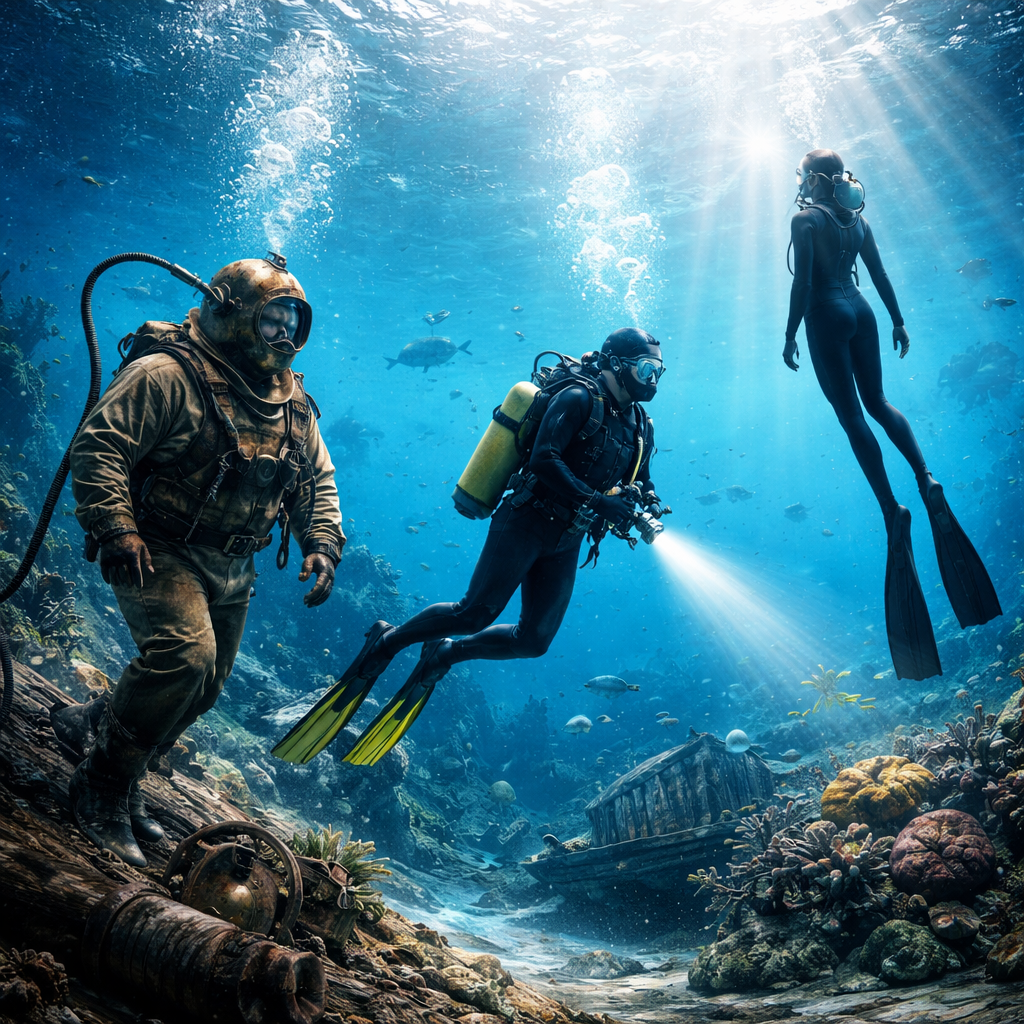
The real turning point came between the 16th and 19th centuries with the introduction of diving bells and later hard-hat diving suits. For the first time, humans were able to breathe underwater thanks to air supplied from the surface.
This was extreme diving—slow, physically demanding, and often deadly. Pressure-related injuries, nitrogen narcosis, and ascent accidents were common. The human body was pushed beyond limits that were not yet understood. Yet every dive contributed to new knowledge.
The Regulator Revolution
The true transformation occurred in the 20th century with the invention of the demand regulator, allowing divers to carry their air supply with them. Breathing underwater was no longer a technical privilege—it became an accessible experience.
This marked the birth of modern scuba diving: freer, safer, and driven by exploration. The sea was no longer just a place of labor or danger, but a space to observe, understand, and respect.
From Necessity to Awareness
Today, breathing underwater is a natural act for those who practice scuba diving, freediving, or mermaid disciplines. Yet behind that simple gesture lies a long history of experimentation, mistakes, sacrifices, and breakthroughs.
Modern diving is not just about technology—it is about training, safety, and awareness. This is where structured pathways such as scuba diving, freediving, and mermaid courses offered by Underwater Academy come into play, guiding students from their very first breath underwater to advanced and professional specialisations.
Breathing Underwater Today
Whether it is an Open Water course, a first freediving experience, or a mermaid training programme, breathing underwater today means doing so safely, knowledgeably, and with respect for the marine environment. Each discipline has its own techniques, but all share the same origin: the human desire to explore what lies beneath the surface.
The history of scuba diving reminds us of one essential truth: every dive is the result of centuries of evolution. And every diver, at the moment of their first underwater breath, becomes part of that story.
- PADI Professional Freediving Courses

- PADI Freediving Specialty Courses

- PADI Freediving Recreational Courses

Discover the scuba diving, freediving, and mermaid courses offered by Underwater Academy and begin your own journey beneath the surface
| YouTube | facebook | instagram | WhatsApp or telegram group |